展覧会寄稿文|秋元雄史(美術評論家) 交感としての「うつし」 ——
展覧会に際し、美術評論家の秋元雄史氏にテキストをご寄稿いただきました。
交感としての「うつし」
——六田知弘 × 橋本雅也
秋元雄史(美術評論家)
本展は、彫刻家・橋本雅也と写真家・六田知弘による二人展であり、「うつし」という行為を通して、世界と人間の関係そのものを再考する試みである。
ここで言う「うつし」とは、対象の形態を一方向的に写し取る模写的行為ではない。それは、主体と客体、見る者と見られるものという近代的な二項対立を揺るがし、意識(私)の外部に広がる世界との相互的な関係生成として理解されるべき概念である。
橋本雅也の彫刻実践は、自然物に手を加えることで、それらが内包してきたものが表出する現象への関心から始まっている。木、動物の角や骨、鉱物、土といった多様な素材を扱いながら、常に表層ではなく、その奥行に潜む構造や時間性へと視線を向けてきた。彼にとって素材は、加工される受動的な対象ではなく、作家の介入によって潜在性を顕在化させる能動的な存在である。
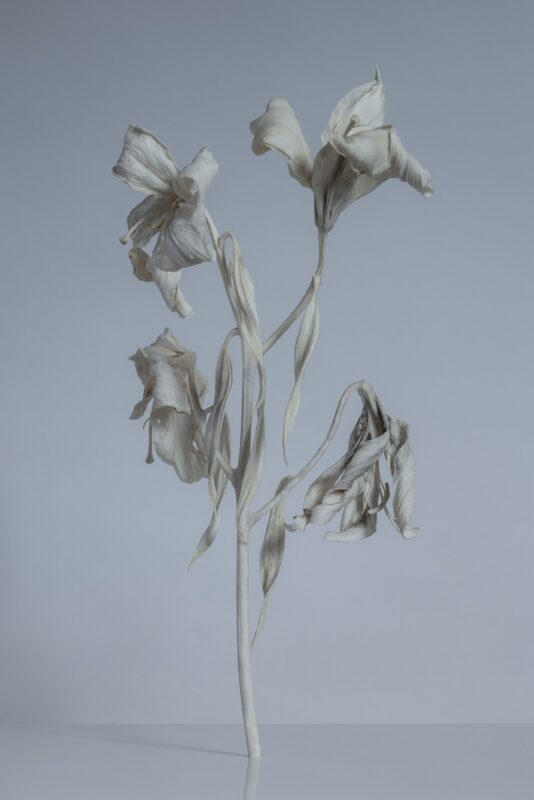
鹿の角や骨、身近な草花をモチーフとした作品群においては、生と死、自然と人為、象徴と実体といった対立項が静かに交錯する。そこでは彫刻は固定された形態ではなく、生成と変容のプロセスとして提示される。形を与えるのではなく、すでにそこに在ったものを引き出す行為なのである。
一方、六田知弘の写真実践は、1980年代初頭にネパール・ヒマラヤのシェルパの村に身を置いた経験に始まる。自然とともに生きる人々との出会いは、「自然や宇宙との根源的なつながり」への志向を決定づけた。
六田の写真は対象の記録ではなく、光・時間・気配が交錯する「場」を定着させる装置として機能する。「地」「水」「火」「風」といったシリーズにおいて、被写体は具体性を保ちながらも、個別性を超え、世界そのものが立ち上がる瞬間へと開かれている。
また六田は、「祈り」と「時」を主題に、日本の仏像、ロマネスク美術、雲岡石窟、ボロブドゥールなど、宗教的・文化的遺産の撮影にも長年取り組んできた。そこでは信仰の対象は単なる美的鑑賞に還元されることなく、人間の祈りと時間の堆積が交錯する場として捉え直される。
ここで「うつし」を抽象化するならば、それは表象以前の世界との接触の形式である。主体が意味づける以前に起こる、感覚と物質、時間と身体の干渉の総体であり、視覚に限らず触覚や重力感覚、時間感覚を含んだ全身的な経験として立ち上がる。
両者の実践が示すのは、作品とは完結した意味を伝達する媒体ではなく、世界との関係が一時的に結晶化する場であるという認識である。写真や彫刻は自然を表すのではなく、自然がこちらに働きかけてくる出来事を受け止める器として存在する。
この態度は、人間中心的な視点を後退させ、人間もまた森羅万象の中で「うつされ続ける存在」であることを示唆する。作品の静けさは、自然への回帰を語るものではなく、世界とともに在ることの困難さと豊かさを問い返している。
写真と彫刻という異なる領域にありながら、二人の実践は視覚中心主義と人間中心主義を静かに解体し、世界とともに在るための感受性を回復させる。本展は、作品を見る場であると同時に、見ることそのものが問い直される場である。
“Utsushi” as Resonance
— Tomohiro Muda × Masaya Hashimoto
Yushi Akimoto (Art Critic)
This exhibition is a two-person show by sculptor Masaya Hashimoto and photographer Tomohiro Muda. Through the act of utsushi¹, it attempts to reconsider the relationship between the world and the human being itself.
Here, utsushi does not refer to a one-directional, imitative act of reproducing the form of an object. Rather, it should be understood as a concept that unsettles the modern binary oppositions of subject and object, seer and seen, and instead suggests the generation of a reciprocal relationship with the world that unfolds beyond consciousness (the self).
Hashimoto’s sculptural practice began with an interest in the phenomenon whereby what is latent within natural materials emerges through human intervention. Working with diverse materials such as wood, animal antlers and bones, minerals, and earth, he has consistently directed his attention not to surface appearances but to the structures and temporalities embedded within them. For Hashimoto, material is not a passive object to be shaped, but an active presence that reveals its own potential through the artist’s engagement.
In works employing deer antlers, bones, and familiar plants as motifs, opposing elements—life and death, nature and artifice, symbol and substance—quietly intersect. Sculpture here is not presented as a fixed form, but as a process of generation and transformation. It is not an act of giving form, but of drawing out what was already there.
Meanwhile, Tomohiro Muda’s photographic practice originates in his experience in the early 1980s living among Sherpa communities in the Himalayas of Nepal. Encounters with people living in close relation to nature shaped his enduring pursuit of a “fundamental connection with nature and the cosmos.”
Muda’s photographs do not function as records of objects; rather, they operate as devices for fixing a “field” in which light, time, and presence intersect. In series such as Earth, Water, Fire, and Wind, while the subjects remain concrete, the images transcend individuality and open onto moments in which the world itself comes into being.
Muda has also long engaged in photographing religious and cultural heritage—Japanese Buddhist sculpture, Romanesque art in Europe, the Yungang Grottoes in China, Borobudur, among others—under the themes of “prayer” and “time.” In these works, objects of faith are not reduced to aesthetic appreciation but are rearticulated as sites where human devotion and the accumulation of time converge.
If we abstract the notion of utsushi, it may be described as a mode of contact with the world prior to representation. It is the totality of subtle interferences between sensation and matter, time and body, occurring before the subject assigns meaning. Seeing here is not limited to vision, but emerges as a full-bodied experience encompassing touch, gravity, and the sense of time.
What both artists’ practices reveal is an understanding that artworks are not vessels for conveying fixed meanings, but sites where relationships with the world momentarily crystallize. Photography and sculpture do not represent nature; rather, they exist as receptacles for receiving events in which nature and material act upon us.
This attitude quietly withdraws from an anthropocentric viewpoint, suggesting instead that humans themselves are beings continuously shaped through utsushi. The stillness that emanates from their works does not speak of a return to nature or a celebration of spirituality, but instead calls into question—at the deepest level of perception—the difficulty and richness of existing with the world.
Though working in distinct mediums of photography and sculpture, Muda and Hashimoto both gently dismantle visual-centrism and anthropocentrism, restoring a sensitivity necessary for being with the world. This exhibition is not only a place for viewing works, but also a site where the very act of seeing is brought into question.
¹ Utsushi: A Japanese concept that exceeds simple notions of “copying” or “representation.” It implies a reciprocal and transformative process in which subject and object, self and world, mutually affect and permeate one another, giving rise to a shared field of presence.
展覧会情報
六田知弘 × 橋本雅也「現しうつ」
- 会期|2026年4月18日(土)〜5月30日(土)
- 会場|ロンドンギャラリー白金
(東京都港区白金3-1-15 白金アートコンプレックス4階) - 開廊時間|11:00〜17:00
- 休廊日|日曜日・月曜日